“I can’t build tools, I’m not a programmer.’ If that’s what you’re thinking, think again. With AI as your team, you absolutely can.”
As a finance leader, with over two decades of experience leading large finance operations, and driving automation in partnership with IT and development experts. My work has always involved defining business problems, shaping the vision for solutions, and ensuring impactful outcomes.
Years ago, I aspired to build a “Kindle-like Sanskrit Reader” — an app that would allow users to read Sanskrit stotras or scriptures and simply tap on any Sanskrit word to instantly see its meaning and pronunciation. The intent was simple yet meaningful: to make Sanskrit more accessible and help preserve the language through technology.
I had even reached out to multiple software firms to explore development of a prototype but soon realised that the development costs were high; development timelines were long with no guarantee of quality or alignment with the vision. And above all, a lack of transparency — it felt like a black box where I had little control over the outcome.
For someone building it out of passion, not profit, the cost-benefit just didn’t make sense. So, I shelved it — like several other ideas that followed. They all had high utility, low commercial potential, and equally high execution barriers.
Then AI changed everything.
The arrival of tools like ChatGPT, GitHub Copilot, and open APIs made it possible to build prototypes without relying on full-fledged tech teams. Suddenly, the barrier between imagination and implementation was gone. With curiosity and persistence, anyone, even professionals like me, with zero development knowledge could create something functional, useful, and scalable.
That shift inspired me to revisit my creative side again — this time I chose a use case from my coaching journey.
I often used ChatGPT during my training and client practice — mostly to simulate conversations, explore perspectives, or test coaching frameworks. It worked, but when I shared it with my peers not many were conversant with AI and also I realised the following:
- Chatting is tiresome as everything needs to be keyed in. The voice mode did help in this regard.
- Prompting had to be precise and structured to get meaningful dialogue but a layperson wouldn’t naturally know.
- Creating a custom GPT improved the experience, but it required a paid subscription, which not everyone could afford or knew how to configure.
- And when I thought about Bharat, I realized another key limitation which is ChatGPT worked only in English, excluding a large part of population that prefers regional languages.
That’s when the idea struck:
A Voice-Enabled AI Coach.
….one that could talk, listen, and coach in multiple Indian languages?
And here’s the twist: I did it without writing a single line of code myself.
The vision was clear– A coach that:
- Feels human, empathetic, and aligned with professional coaching standards
- Is Multilingual and speaks English, Hindi, Kannada, and potentially more
- Real-time voice and text conversation so that the session is seamless
- Context retention so the dialogue feels natural and progressive
- Coaching aligned with ICF (International Coaching Federation) practices
- And remains accessible to everyone — regardless of tech skills or language
Basically, an AI coach that embodies a full spectrum of professional coaching skills, from Cognitive Behavioral techniques to leadership frameworks, emotional intelligence, active listening, and structured goal-setting.
Assembling my Development Team
The first step was to recruit my development team that will help me build this tool. My development team wasn’t a group of people, but a pair of powerful AI tools: ChatGPT as my strategist and GitHub Copilot as my coder.
ChatGPT gave me confidence that the idea could work, shaped the persona of my AI coach, and helped define the coaching style, tone, and flow. It was like brainstorming with a super-knowledgeable partner who always had time for me.
GitHub Copilot suggested frameworks, tools, and implementation paths. Together, we iterated, refined, and sometimes scrapped approaches when things didn’t match my vision. Frustrating at times, yes — but always productive.
💡 The aha moment for me was unfolding as I watched the features take shape and work seamlessly specially when I tested the multi-turn conversation and it just worked.
The Architecture Behind My Voice-Enabled AI Coach (Click to Expand)
Here’s how it all came together:
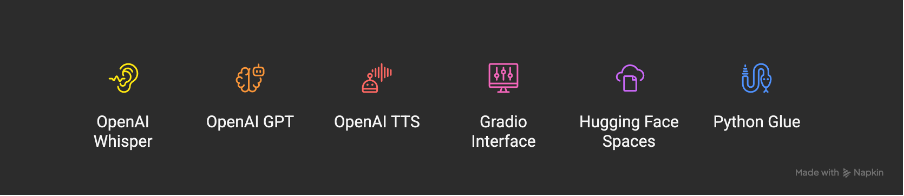
👂 OpenAI Whisper (The Ear):-
Converts spoken input into text. Robust enough to handle multiple languages and accents. Integrated via OpenAI’s API.
🧠 OpenAI GPT (The Brain):–
Powers empathetic, context-aware, coaching-style dialogue. Responds in any supported languages dynamically and maintains session context to enable multi-turn conversations.
🗣️ OpenAI TTS (The Voice):–
Converts responses into natural-sounding speech while displaying text for accessibility.
🖥️ Gradio (The Interface):-
A simple, intuitive front-end with audio recording, playback, and live transcripts.
☁️ Hugging Face Spaces (The Host):-
Cloud platform where I deployed the app, making it easy to share and use.
🐍 Python (The Glue):-
Tied it all together, handling the back-end logic, audio processing, and privacy safeguards.
The result? A functional, accessible prototype of a multilingual, Voice-Enabled AI Coach.
“Iteration isn’t a setback; it’s the fastest way forward.”
My journey to this final version wasn’t a straight line; it was a valuable lesson in iteration. My first, attempt was built using Streamlit for the interface, the powerful GPT-4o model, and premium, expressive voices from ElevenLabs. While it felt incredibly advanced for a single exchange, it hit a critical wall—it struggled to “remember” the conversation’s history, breaking the flow after the first turn. This challenge, led me to pivot. I decided to build a new, more robust version from the ground up, focusing on a solid foundation, which led to the successful architecture detailed above.
So, What Does This Actually Mean for Us?
What excites me isn’t just the tool — it’s the paradigm shift.
In the past, creating something like this would require:
- Hiring developers and UX designers.
- Long development timelines.
- Significant upfront investment.
- Endless iterations due to communication gaps between “business” and “tech.”
For many individuals or small teams, this meant their ideas never left the drawing board.
Now? With AI as your collaborator, you can go from idea to prototype in weeks, even days.
That’s transformational. It lowers barriers, reduces cost, and empowers people like me — finance professionals, leaders, creators — to turn vision into reality without waiting for permission or resources.
My Key Takeaways from This Journey
I’ve also used AI to automate personal finance processes and build dashboards — topics I’ll be sharing in my upcoming blogs.
AI isn’t about replacing us — it’s about making us limitless, regardless of our technical background.